
A fresh-looking complexion in the morning often starts with a simple skincare routine. Cleanse your face, apply a few lightweight products, finish with sunscreen, and get on with your day.
One ingredient that has become especially popular in morning routines is vitamin C.
But what actually happens to your skin when you use a Vitamin C Serum every morning? Does it really make your skin brighter? Can it help with dark spots? Does it protect your face from the sun? And how long does it take to notice a difference?
Vitamin C is a powerful antioxidant that has been studied for its potential role in protecting skin from oxidative stress, supporting collagen production, and improving the appearance of pigmentation and photoaging. However, the results depend on the formulation, concentration, stability, consistency of use, and your overall skincare routine.
For Pakistani skincare users, adding vitamin C to a morning routine can be particularly interesting because daily sun exposure, heat, and environmental stress can contribute to dullness and uneven-looking skin.
Let’s look at what you can realistically expect.
What Does Vitamin C Do for Your Skin?
Vitamin C, also known as ascorbic acid, is an antioxidant. Antioxidants help counter oxidative stress caused by unstable molecules known as free radicals.
Your skin encounters oxidative stress from several environmental factors, including ultraviolet radiation and pollution. Topical vitamin C has been studied for its antioxidant, photoprotective, anti-aging, and pigmentation-related effects.
It may help support several aspects of skin appearance, including:
- Uneven skin tone
- Visible pigmentation
- Dull-looking skin
- Signs of photoaging
- Fine lines and wrinkles
- Overall skin brightness
However, vitamin C is not a magic solution. It cannot completely prevent sun damage, replace sunscreen, or transform your skin overnight.
The best results usually come from using it consistently as part of a balanced skincare routine.
What Happens When You Apply Vitamin C Every Morning?
Using a Vitamin C Serum consistently in the morning can provide several potential benefits over time.
The changes are usually gradual rather than dramatic. You may first notice that your skin looks fresher or more even, while improvements in pigmentation and signs of photoaging can take longer.
Here’s what may happen.
1. Your Skin Gets Antioxidant Support
One of the main reasons vitamin C is popular in morning skincare is its antioxidant activity.
Throughout the day, your skin is exposed to environmental stressors. UV radiation is one of the most important sources, but pollution and other factors can also contribute to oxidative stress.
Topical vitamin C can provide antioxidant activity within the skin. Research reviews describe vitamin C as an important topical antioxidant with potential photoprotective effects.
This does not mean you can apply vitamin C and forget about sunscreen.
Think of vitamin C as a supporting step rather than your primary sun-protection method.
2. Your Skin May Look Brighter
Dull skin can make your complexion appear tired even when you have had enough sleep.
Vitamin C is often used in skincare because of its potential effect on pigmentation and overall skin tone.
Clinical research has found evidence that topical vitamin C may improve uneven pigmentation and some signs of photoaging, although researchers also note that more studies are needed to establish the ideal formulation and concentration.
With consistent use, your complexion may gradually appear more radiant and even.
Importantly, “brighter skin” does not mean changing your natural skin color.
A realistic goal is a more even-looking complexion with reduced appearance of certain areas of discoloration.
3. Dark Spots May Become Less Noticeable
Dark spots can develop after acne, inflammation, or sun exposure.
Vitamin C has been investigated for its effects on melanin production and hyperpigmentation. Reviews of topical vitamin C have reported potential depigmenting and skin-brightening effects.
However, results are not instant.
If you are using vitamin C for pigmentation, consistency is important. The systematic review of topical vitamin C for melasma and photoaging found improvements in pigmentation in some studies, while also noting that noticeable changes may require longer-term use.
So, don’t judge your serum after three or four mornings.
Give your routine enough time to work.
4. Your Skin May Get Better Support Against Photoaging
Sun exposure is one of the major contributors to premature skin aging.
Over time, UV exposure can contribute to changes such as uneven pigmentation, fine lines, wrinkles, and loss of skin quality.
Vitamin C has been studied for its role in protecting against photoaging and supporting collagen-related processes.
This is one reason morning application makes sense.
You are applying an antioxidant before your skin faces another day of environmental exposure.
But there is an important rule:
Vitamin C does not replace sunscreen.
Use a broad-spectrum sunscreen every morning and reapply when appropriate, especially if you spend significant time outdoors.
5. Your Skin May Look More Even Over Time
Uneven skin tone can come from several sources, including sun exposure, acne marks, and pigmentation.
Vitamin C may help improve the appearance of some forms of discoloration by influencing pathways involved in melanin production. Research has identified anti-pigmentary effects among the mechanisms associated with topical vitamin C.
With regular use, this may contribute to a more uniform-looking complexion.
However, not every dark patch has the same cause.
Persistent or worsening pigmentation may require evaluation by a dermatologist, especially if over-the-counter skincare does not improve it.
6. Your Skin May Receive Collagen Support
Collagen is an important structural protein in the skin.
As we age, collagen production changes, contributing to fine lines, wrinkles, and reduced firmness.
Vitamin C plays an important role in collagen synthesis, and topical vitamin C has been investigated for its anti-aging effects.
This does not mean a vitamin C serum will erase wrinkles.
Instead, regular use may support a broader anti-aging skincare routine.
Think of it as one piece of the puzzle rather than a complete anti-aging treatment on its own.
Why Is Morning the Best Time to Use Vitamin C?
Vitamin C can be used at different times depending on the formulation and your routine.
However, many people prefer morning application because vitamin C provides antioxidant support during the day and can complement sunscreen.
Dermatology guidance commonly recommends applying vitamin C after cleansing and before moisturizer and sunscreen.
A simple morning routine can look like:
Cleanser → Vitamin C Serum → Moisturizer → Sunscreen
This keeps your routine easy to follow without layering too many products.
Can Vitamin C and Sunscreen Be Used Together?
Yes.
In fact, combining topical vitamin C with sunscreen is a popular approach because they provide different forms of protection.
Sunscreen is designed to protect against UV radiation, while vitamin C provides antioxidant activity.
Research and dermatology guidance suggest that topical vitamin C can complement sunscreen rather than replace it.
This is particularly relevant for people living in sunny climates.
If you live in Pakistan and spend time outdoors, don’t make the mistake of thinking that vitamin C alone is enough protection.
Apply sunscreen generously and use additional sun-protective habits when appropriate.
How Long Does Vitamin C Take to Show Results?
This is where patience becomes important.
You may notice a fresh or hydrated appearance relatively quickly, depending on the product and your skin. But changes in pigmentation, fine lines, and photoaging usually take longer.
A systematic review of topical vitamin C for melasma and photoaging found evidence of improvements in pigmentation and skin appearance but noted that longer-term use may be necessary for noticeable changes.
Your results can also depend on:
- Vitamin C form
- Concentration
- Product stability
- Skin type
- How often you use it
- Sun exposure
- Your other skincare products
- The cause of your pigmentation
Instead of checking your face every morning, take a photo once every few weeks under similar lighting.
That gives you a much better way to judge gradual changes.
What Happens If You Use Too Much Vitamin C?
More skincare is not always better.
Using too much product or choosing a formulation that your skin does not tolerate can lead to irritation.
Some people may experience:
- Stinging
- Redness
- Dryness
- Burning or discomfort
- Increased sensitivity
This is particularly possible with certain formulations of L-ascorbic acid, especially at higher concentrations.
If your skin is sensitive, start gradually and follow the product’s instructions.
If significant or persistent irritation occurs, stop using the product and consider speaking with a qualified dermatologist.
Does a Higher Vitamin C Percentage Mean Better Results?
Not necessarily.
It is easy to look at a skincare label and assume that the product with the highest percentage must be the most effective.
Vitamin C is more complicated than that.
The form of vitamin C, pH, formulation, packaging, stability, and ability to penetrate the skin can all influence performance.
L-ascorbic acid is particularly prone to instability, which is why researchers have investigated different derivatives and formulation strategies.
So instead of choosing a product simply because it has a very high percentage, look at the complete formulation and choose something your skin can tolerate consistently.
Why Does Vitamin C Serum Sometimes Change Color?
If your vitamin C serum changes from a light appearance to yellow, orange, or brown, oxidation may be occurring.
Vitamin C, particularly L-ascorbic acid, is sensitive to environmental conditions such as oxygen, light, and heat. Product formulation and packaging are therefore important considerations.
This is one reason vitamin C products are often packaged in ways intended to limit exposure to light and air.
Follow the manufacturer’s storage instructions and keep your product away from unnecessary heat and direct sunlight.
If a product has changed significantly in appearance, smell, or texture, check the manufacturer’s guidance before continuing to use it.
Can Pakistani Skin Types Use Vitamin C Every Morning?
Yes, many Pakistani skincare users can incorporate vitamin C into a morning routine.
However, “Pakistani skin” does not describe one single skin type.
People in Pakistan can have oily, dry, combination, sensitive, acne-prone, or normal skin. Skin tone and pigmentation concerns can also vary considerably.
Your routine should therefore be based on your individual skin rather than nationality alone.
For oily skin, a lightweight serum and moisturizer may feel more comfortable.
For dry skin, pair vitamin C with a hydrating moisturizer.
For sensitive skin, introduce it gradually and choose a formulation that your skin tolerates well.
Can Vitamin C Help With Acne Marks?
It may help with the appearance of post-inflammatory pigmentation, which is one reason vitamin C is often included in brightening routines.
However, vitamin C does not treat every cause of acne or prevent new breakouts by itself.
If you continue to develop acne, treating the underlying acne is important. Otherwise, new marks may continue appearing even while older pigmentation fades.
A dermatologist can help if acne is persistent, painful, or leaving significant marks.
How to Add Vitamin C to Your Morning Routine
If you’re new to vitamin C, keep things simple.
1: Cleanse
Use a gentle cleanser appropriate for your skin type.
You don’t need to scrub your face aggressively to prepare it for serum.
2: Apply Vitamin C Serum
Apply your vitamin C product according to its instructions.
Avoid getting the product directly into your eyes.
3: Moisturize
Use a moisturizer that matches your skin’s needs.
Even oily skin can benefit from appropriate hydration.
4: Apply Sunscreen
Finish with broad-spectrum sunscreen.
This step is especially important if you are concerned about pigmentation, premature aging, or daily sun exposure.
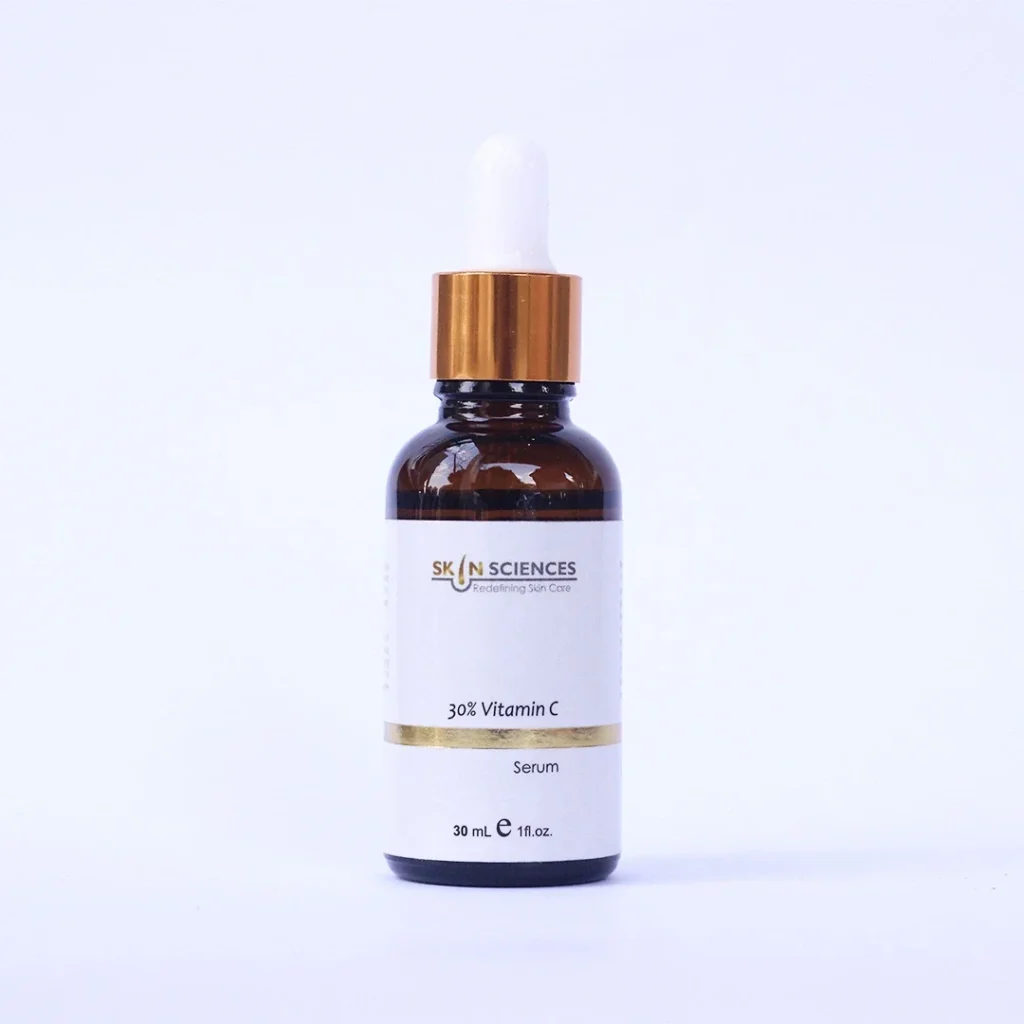
What About Skin Sciences Vitamin C Serum?
If you are looking to add vitamin C to your morning skincare routine, Skin Sciences can be one option to consider.
A Skin Sciences Vitamin C Serum can be incorporated into a routine focused on improving the appearance of dullness, uneven tone, and pigmentation-related concerns.
However, the most important thing is not simply choosing a product with “vitamin C” written on the label.
Look at the overall formulation, follow the product directions, store the serum appropriately, and give your routine enough time.
If your skin is sensitive, introduce the product carefully rather than immediately adding several new active ingredients.
Common Vitamin C Mistakes to Avoid
Using vitamin C without sunscreen
Vitamin C should complement your sun-protection routine, not replace it.
Applying too many active ingredients
Using vitamin C alongside multiple acids, retinoids, and other strong products can increase the chance of irritation.
Expecting overnight results
Pigmentation and photoaging-related changes take time.
Ignoring product storage
Vitamin C can be sensitive to light, oxygen, and heat, so proper storage matters.
Choosing a product only because it has a higher percentage
Concentration is only one part of a formulation.
Using an irritating product every day
Daily use is not automatically better if your skin is becoming irritated. Adjust your routine according to your skin’s tolerance.
Frequently Asked Questions
Is it okay to use Vitamin C Serum every morning?
Many people can use a Vitamin C Serum daily, provided their skin tolerates the formulation. Follow the product’s instructions and reduce frequency if irritation develops.
Can I use vitamin C without sunscreen?
You can technically apply vitamin C without sunscreen, but that is not a good daytime skincare strategy. Vitamin C does not replace sunscreen. A morning antioxidant routine works best alongside appropriate sun protection.
Does vitamin C make skin lighter?
Vitamin C may help improve the appearance of hyperpigmentation and uneven skin tone. It should not be viewed as a product that changes your natural skin color. Research supports its potential depigmenting effects, although results vary.
Can vitamin C remove dark spots completely?
No skincare ingredient can guarantee that every dark spot will disappear. Vitamin C may help reduce the appearance of some pigmentation over time, but the cause and severity of the pigmentation matter.
Can I use vitamin C on sensitive skin?
Some people with sensitive skin can use vitamin C, but stronger formulations may cause irritation. Start gradually and stop if you experience significant burning, swelling, or persistent redness.
Why does my vitamin C serum turn brown?
A change toward yellow, orange, or brown can indicate oxidation, depending on the product. Vitamin C, particularly L-ascorbic acid, is sensitive to oxygen, light, and heat.
Should I use vitamin C before or after moisturizer?
Generally, a serum is applied before moisturizer. A simple routine is cleanser, Vitamin C Serum, moisturizer, and then sunscreen in the morning.
Final Words
Using a Vitamin C Serum every morning can be a useful step in a well-planned skincare routine.
Over time, vitamin C may provide antioxidant support, help improve the appearance of uneven pigmentation, support collagen-related processes, and contribute to a brighter, more even-looking complexion. Research supports several of these potential benefits, although the strength of evidence varies between formulations and skin concerns.
For Pakistani skincare users, the most practical approach is to keep expectations realistic.
Vitamin C is not a substitute for sunscreen, it will not transform your skin overnight, and a higher concentration does not automatically guarantee better results.
Instead, choose a suitable formulation, introduce it carefully, store it properly, use it consistently, and protect your skin from daily UV exposure.
If you are considering a Skin Sciences Vitamin C Serum, make it part of a complete routine rather than relying on one product alone.
Healthy-looking skin is built through consistency—not complicated routines.