
If you have acne-prone skin, humid weather can make your skincare routine feel much harder to manage.
Your face may become oilier, sweat more, and feel sticky throughout the day. At the same time, clogged pores and breakouts can seem more frequent. When you add exfoliating acids to the routine, you may also wonder whether they will help your skin or simply make it irritated.
This is where mandelic acid can be an interesting option.
Mandelic acid is an alpha hydroxy acid (AHA) used in skincare for exfoliation and concerns such as uneven texture, dullness, and the appearance of blemishes. Because of its larger molecular size compared with some other AHAs, it is often considered a gentler exfoliating option.
But does that make a Mandelic Acid Serum suitable for acne-prone skin in humid weather?
The answer depends on your skin, the formulation, how often you use it, and the rest of your skincare routine.
Let’s take a closer look.
What Is Mandelic Acid?
Mandelic acid is an AHA derived from bitter almonds. Like other AHAs, it works primarily on the skin’s surface by helping loosen the bonds between dead skin cells.
This exfoliating action can help improve the appearance of rough texture and dullness over time.
Mandelic acid is also commonly included in skincare products designed for acne-prone or uneven-looking skin.
One reason it attracts attention is its relatively large molecular size. Larger molecules generally penetrate the skin more slowly than smaller ones, which is one reason mandelic acid is often described as a gentler AHA.
However, “gentler” does not mean irritation-free.
Any exfoliating acid can cause dryness, stinging, redness, or irritation if it is used too frequently or if the formula is too strong for your skin.
Why Can Humid Weather Be Challenging for Acne-Prone Skin?
Humidity changes the way your skin feels.
In hot and humid conditions, your skin may produce more sweat and feel oilier or stickier. Sweat can mix with sebum, sunscreen, makeup, and other products on the skin’s surface.
This does not mean humidity directly causes acne in everyone.
However, people who are already prone to clogged pores may find that their skin feels more congested in hot weather.
You may notice:
- More shine
- Increased sweating
- A sticky feeling
- More visible clogged pores
- Occasional breakouts
- Makeup becoming difficult to manage
Your skincare routine therefore needs to balance exfoliation with hydration and barrier support.
Using stronger products simply because your skin feels oily can sometimes backfire.
Can Mandelic Acid Help Acne-Prone Skin?
It may.
Mandelic acid provides chemical exfoliation, which can help remove dead skin cells from the skin’s surface and improve the appearance of uneven texture.
Some research has investigated mandelic acid in acne-related skincare and chemical peel treatments. Studies have reported potential benefits for acne and post-inflammatory hyperpigmentation, although results depend on the concentration, formulation, treatment method, and individual skin characteristics.
This distinction is important.
A leave-on Mandelic Acid Serum is not exactly the same as a professionally performed chemical peel.
You should therefore avoid assuming that results from clinical procedures automatically apply to every cosmetic serum.
For everyday skincare, the goal should be controlled, gradual exfoliation rather than aggressively stripping the skin.
How Can Mandelic Acid Support Acne-Prone Skin?
There are several reasons mandelic acid may be useful in a routine for acne-prone skin.
1. It Exfoliates Dead Skin Cells
Dead skin cells naturally build up and shed from the skin.
When the surface becomes rough or uneven, gentle chemical exfoliation can help improve its appearance.
Mandelic acid can loosen connections between surface skin cells, helping exfoliate the outer layer.
This can leave the skin feeling smoother over time.
2. It Can Improve the Appearance of Uneven Texture
Acne-prone skin may develop rough or uneven texture.
Regular but controlled exfoliation may help make the skin surface appear smoother.
However, you do not need to exfoliate aggressively to get this benefit.
Using an acid too often can irritate the skin and potentially make your overall complexion look worse.
3. It May Help With Post-Acne Marks
Acne often leaves behind dark marks after the breakout has healed.
These marks are commonly referred to as post-inflammatory hyperpigmentation.
Mandelic acid has been studied as part of approaches for hyperpigmentation, but the cause and depth of pigmentation matter.
If your primary concern is persistent or severe pigmentation, professional evaluation may be more appropriate than relying entirely on an exfoliating serum.
4. It Can Help Dull-Looking Skin
Dead surface cells can contribute to a dull appearance.
Controlled exfoliation may help reveal a smoother-looking surface.
But brighter-looking skin should not come at the cost of irritation.
Healthy skin is more important than trying to create an instant glow.
Is Mandelic Acid Better Than Stronger Acids for Acne-Prone Skin?
“Better” is not always the right comparison.
Different acids have different characteristics.
Glycolic acid, for example, has a smaller molecular size and can penetrate more readily. Salicylic acid is a beta hydroxy acid (BHA) that is oil-soluble and particularly relevant to oily and acne-prone skin.
Mandelic acid is an AHA that is often chosen by people looking for a gentler exfoliating approach.
That does not mean it will work better for everyone.
Your choice should depend on your skin concerns, sensitivity, existing routine, and how your skin responds.
Mandelic Acid vs Salicylic Acid for Acne
This is a common question.
Salicylic acid is oil-soluble and can work within oily environments, making it particularly popular in products targeting acne and clogged pores.
Mandelic acid mainly provides surface exfoliation and may be useful for texture, dullness, and the appearance of post-acne marks.
Some people may benefit from one ingredient, while others may use different actives at different times.
You do not necessarily need to combine them.
If you already use several acne treatments, adding another exfoliating acid without considering the overall routine may increase irritation.
Can You Use Mandelic Acid in Humid Weather?
Yes, but your routine may need to be adjusted.
Humid weather does not automatically make mandelic acid unsafe.
The bigger concern is how your skin responds.
If your face is oily and sweaty, you may be tempted to use more exfoliating products.
That is usually not a good strategy.
Instead, focus on:
- Gentle cleansing
- Controlled exfoliation
- Lightweight hydration
- Appropriate sunscreen
- Avoiding unnecessary active ingredients
A simple routine can be more effective than a complicated one.
How Often Should You Use a Mandelic Acid Serum?
There is no universal schedule that works for everyone.
If you are new to mandelic acid, starting slowly is generally a sensible approach.
For example, you may begin with occasional use according to the product’s instructions and observe how your skin reacts.
If your skin remains comfortable, you can continue following the recommended frequency.
Do not increase frequency simply because you want faster results.
Signs that you may be using an exfoliating product too often include:
- Persistent redness
- Burning
- Excessive dryness
- Peeling
- Increased sensitivity
- Discomfort when applying other skincare products
If these symptoms develop, stop or reduce the irritating product and allow your skin to recover.
Can Mandelic Acid Cause More Acne?
Mandelic acid is not expected to directly cause acne simply because it is an exfoliating acid.
However, irritation can create problems.
If you use too much acid or combine several irritating products, your skin barrier can become stressed.
You may then experience redness, dryness, burning, or increased sensitivity.
If breakouts suddenly appear after introducing a new product, don’t automatically assume that the product is “purging.”
Sometimes the product may simply be irritating your skin or may not be suitable for you.
This is why introducing one new active at a time is helpful.
How Should You Use Mandelic Acid in Humid Weather?
A simple routine can make the process easier.
Morning
Gentle cleanser → Lightweight moisturizer → Sunscreen
If you use a serum in the morning, choose products that are compatible with your skin and follow their instructions.
Evening
Cleanser → Mandelic Acid Serum → Moisturizer
Apply the serum according to the product directions.
Avoid applying it to broken, irritated, or freshly damaged skin.
If your skin is sensitive, introduce the product gradually.
Why Is Moisturizer Important When Using Mandelic Acid?
Exfoliation and hydration should work together.
Many people with oily or acne-prone skin skip moisturizer because they are afraid of looking greasy.
But oily skin can still become dehydrated.
A suitable lightweight moisturizer can help maintain skin comfort and support the skin barrier.
Look for a formula that suits your skin type rather than automatically choosing the richest cream available.
In humid weather, lightweight gel or lotion textures may feel more comfortable.
Why Is Sunscreen Essential?
This is especially important when using exfoliating acids.
Your daytime routine should include broad-spectrum sunscreen.
Sun exposure can contribute to pigmentation and make post-acne marks more difficult to manage.
If you are using mandelic acid to improve the appearance of uneven tone or acne marks, consistent sun protection supports your overall skincare strategy.
Remember:
Mandelic acid exfoliates. Sunscreen protects from UV exposure.
They are not interchangeable.
What Ingredients Should You Avoid Combining With Mandelic Acid?
You do not necessarily have to avoid every active ingredient permanently.
The main concern is stacking too many potentially irritating products in the same routine.
Be cautious when combining mandelic acid with:
- Other exfoliating acids
- Strong retinoids
- Benzoyl peroxide
- Other potentially irritating acne treatments
Whether a combination is appropriate depends on the products, concentrations, frequency, and your skin’s tolerance.
If you already have an active-heavy routine, adding another acid may be unnecessary.
When in doubt, keep the routine simple.
Can You Use Mandelic Acid With Niacinamide?
Mandelic acid and niacinamide can generally be included in the same overall skincare routine.
However, you don’t have to use every active at the same time.
For sensitive or acne-prone skin, separating potentially irritating products can make it easier to identify what is working and what is causing discomfort.
For example:
Morning: Niacinamide → Moisturizer → Sunscreen
Evening: Mandelic Acid Serum → Moisturizer
This is only an example.
Your routine should be based on your specific products and skin tolerance.
Can Mandelic Acid Help With Oily Skin?
It can be useful for improving the appearance of surface texture, but it should not be viewed as a treatment for excess oil production.
If oily skin is your main concern, focus on a complete routine.
Use a gentle cleanser, a lightweight moisturizer, and sunscreen.
If you are experiencing persistent or moderate-to-severe acne, consider consulting a dermatologist rather than relying only on cosmetic exfoliation.
Is Mandelic Acid Suitable for Sensitive Skin?
It may be better tolerated by some people than stronger exfoliating acids, but sensitive skin still requires caution.
“Gentle” does not mean that everyone will tolerate it.
If your skin is reactive, start with low frequency and avoid combining multiple exfoliating products.
Patch testing can also be useful when introducing a new product, although it cannot guarantee that you will not experience irritation after applying the product more broadly.
What Makes a Good Mandelic Acid Serum?
When choosing a Mandelic Acid Serum, don’t focus only on the percentage.
Consider the complete formulation.
Concentration
A higher concentration is not automatically better.
Supporting Ingredients
Hydrating and soothing ingredients may make a formula more comfortable to use.
Packaging
Good packaging can help protect a skincare formula from environmental exposure.
Instructions
A trustworthy product should provide clear directions for application and appropriate warnings.
Your Skin Type
A formula that suits oily skin may not feel right on dry or sensitive skin.
Realistic Claims
Be cautious with products promising instant acne removal, permanent whitening, or flawless skin overnight.
Skincare results usually take time.
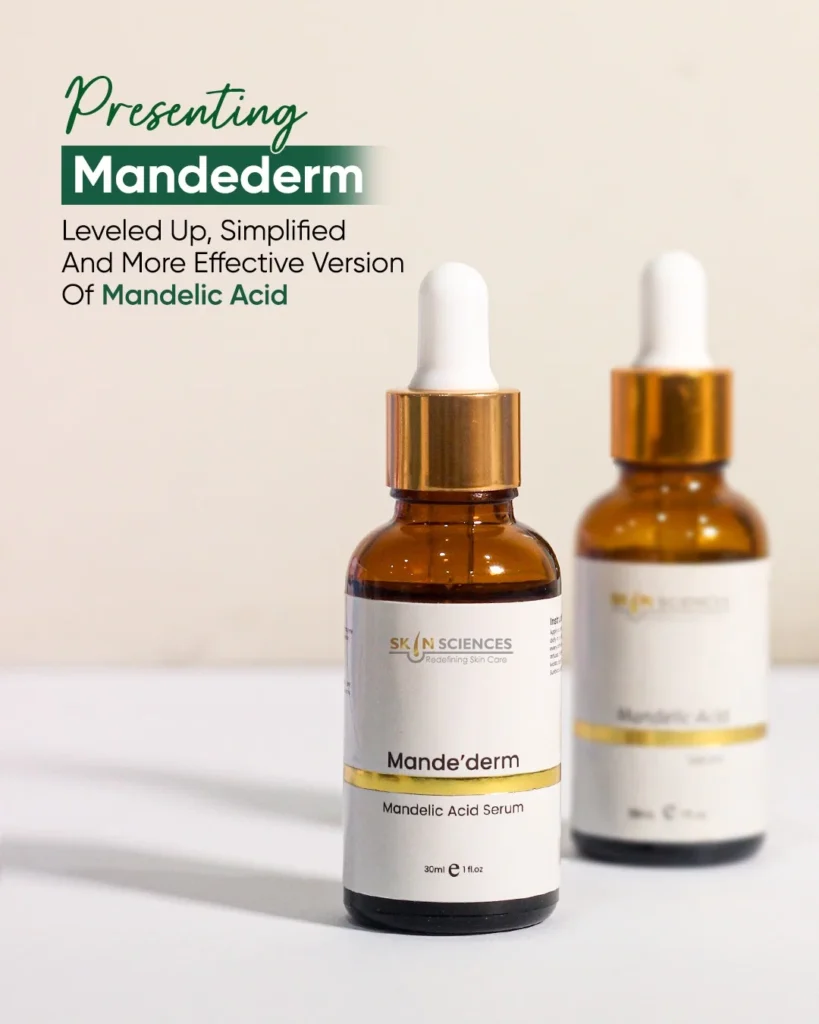
What About Skin Sciences Mandelic Acid Serum?
If you are looking to introduce mandelic acid into your routine, Skin Sciences is one option you can consider.
A Skin Sciences Mandelic Acid Serum can be used as part of a skincare routine focused on exfoliation, uneven texture, and the appearance of post-acne marks, depending on the product’s specific formulation and directions.
The important point is to use it correctly.
Don’t choose a serum simply because you see a high percentage on the label.
Instead, consider whether the formulation fits your skin, whether you can use it comfortably, and whether it works well with the rest of your routine.
Common Mandelic Acid Mistakes to Avoid
Using it every night immediately
Your skin may need time to adjust.
Start according to the product instructions.
Combining multiple exfoliants
Using several acids together can increase irritation.
Skipping moisturizer
Exfoliation does not eliminate your need for hydration.
Forgetting sunscreen
UV exposure can worsen pigmentation and work against your skincare goals.
Applying it to irritated skin
Do not use exfoliating acids on skin that is already burning, peeling, or damaged.
Expecting instant acne removal
Acne and pigmentation usually require consistent care.
Using more product than recommended
More serum does not automatically mean faster results.
Frequently Asked Questions
Is mandelic acid good for acne-prone skin?
It may be a useful exfoliating ingredient for some acne-prone users, particularly when concerns include uneven texture and post-acne marks. However, it is not a universal acne treatment.
Can I use mandelic acid in humid weather?
Yes. Humidity itself does not make mandelic acid unsuitable. However, hot and humid conditions may make oily or acne-prone skin feel more congested, so a lightweight and simple routine may be more comfortable.
How often should I use Mandelic Acid Serum?
Follow the product instructions and start gradually if you are new to exfoliating acids. Avoid increasing frequency simply to achieve faster results.
Can mandelic acid remove acne scars?
It may help improve the appearance of some superficial pigmentation and uneven texture, but true acne scars—especially indented scars—usually require different treatment approaches.
Can mandelic acid reduce dark acne marks?
It may help improve the appearance of post-inflammatory hyperpigmentation as part of a consistent skincare routine. Daily sun protection is also important.
Can I use mandelic acid with niacinamide?
These ingredients can generally be included in the same skincare routine. If your skin is sensitive, consider using them at different times or on different days.
Can mandelic acid make skin dry?
Yes. Like other exfoliating acids, mandelic acid can cause dryness or irritation if used too frequently or if the formula is too strong for your skin.
Should I use sunscreen after mandelic acid?
Yes. Use broad-spectrum sunscreen during the day, especially when your routine includes exfoliating acids.
Is mandelic acid better than salicylic acid for acne?
Neither is universally better. Salicylic acid is particularly useful for oily and acne-prone skin because it is oil-soluble, while mandelic acid provides AHA-based exfoliation and may be useful for texture and pigmentation concerns.
Final Words
So, can mandelic acid be a good choice for acne-prone skin in humid weather?
Yes, it can be provided you use it carefully and your skin tolerates it.
Mandelic acid offers controlled chemical exfoliation and may help improve the appearance of rough texture, dullness, clogged-looking skin, and post-acne marks.
Its relatively larger molecular size is one reason it is often considered a gentler AHA, but that does not make it irritation-proof.
For people living in Pakistan’s hot and humid conditions, the key is balance.
Don’t respond to oily skin by aggressively exfoliating it.
Instead, build a simple routine around:
Gentle cleansing → Appropriate Mandelic Acid Serum use → Lightweight moisturizer → Daily sunscreen
If you’re considering a Skin Sciences Mandelic Acid Serum, follow its specific usage instructions and introduce it gradually if you are new to chemical exfoliation.
And remember: healthier-looking skin is not created by using the strongest products possible.
The goal is to exfoliate enough to support smoother-looking skin without disrupting the barrier that keeps your skin comfortable and healthy.